The Audio Sommelier · Industry Voices
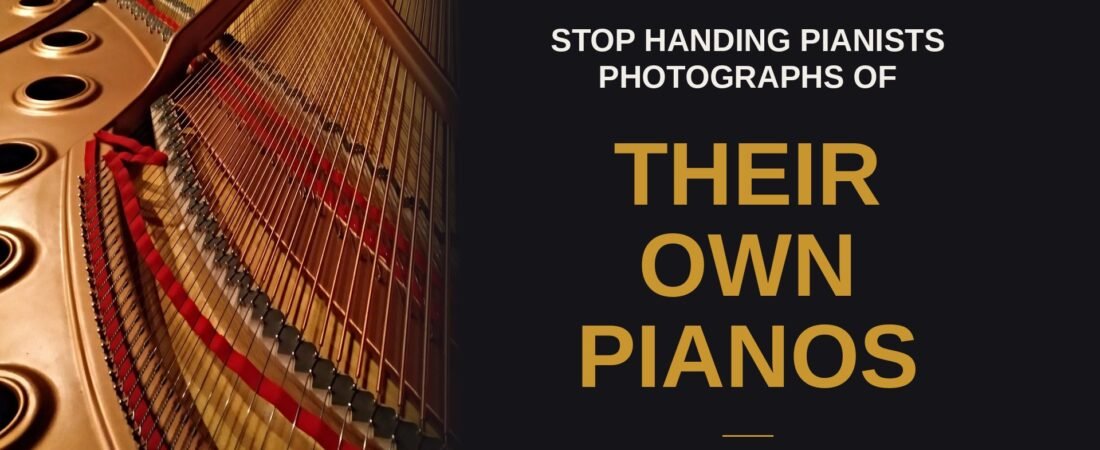
Stop Handing Pianists Photographs Of Their Own Pianos
A piano is not just a series of sounds. It is a magical space several metres wide and the player has the pleasure to sit right in the middle of it all.

Every pianist on earth has been handed a photograph of their own piano and told it’s the instrument. A neural acoustic headset, built to replace headphones, hands them the piano back.
Let’s shift gears for a moment.
Can you walk through your own house in the dark in the middle of the night?
People who can do this aren’t remembering a photograph of their house. They know the shape of it.
Physically.
The way you know where your own hands are.
Now imagine somebody shows you a photograph of a hallway and asks whether you can do the same thing after studying it.
That’s what we’ve been doing to pianists.
WHY DOES A PIANO SOUND FLAT ON OUR HEADPHONES?
An acoustic piano is enormous.
The low strings stretch to the left. The high strings to the right. The soundboard is underneath everything with a lid above it and a space around all of it.
Tom Hanks understood this in Big. He didn’t play the giant piano in FAO Schwarz. He walked across it. Low notes at one end of the floor, high notes at the other.
Sit at a real one for long enough and you don’t just learn what a piano sounds like. You learn where it is.
A pianist spends years sitting in the same place in relation to this enormous acoustic object until its geography becomes completely normal, part of themselves.
Their hands know it.
Their ears know it.
Their whole body knows it.
Which is why something interesting happens when you take all of that and record it.
The piano is still there.
If it’s been recorded properly, so is its space.
Then we play it back through two speakers or a pair of headphones and ask the pianist to accept that version of the instrument as the instrument itself.
Here’s why it comes back flat. Our outer ears sense every sound at a different level, with micro differences in timing, depending on the direction it comes from. Their ridges and hollows reshape it before it reaches the ear canal. They take that information in and deliver it to our brains through the nerves and cartilage, and our brains create spatial reality from it.
It’s the master control panel of our sense of hearing. Headphones deliver the audio wave straight into the ear canal and bypass it.
The photograph of the hallway.
Accurate.
Recognisable.
And flat.
WHAT DO PIANISTS NOTICE FIRST?
I’ve given demo IRL sessions to professional pianists and keyboard players.
They don’t talk to me about frequency response.
They notice the space.
The piano takes up space again.
And that’s when it becomes real.
With a properly recorded piano, the low end returns to the left where the long strings live.
The top returns to the right.
The instrument opens up in front of you.
It has width.
Distance.
A position.
The room around it has a size.
You’re no longer hearing the sound of a piano presented between your ears.
The actual piano is there, close enough to reach out and lift the lid.
That difference sounds ridiculously simple until you experience it.
They don’t talk to me about frequency response. They notice the space.
WHAT IS A NEURAL ACOUSTIC HEADSET?
It’s a headset made from one person’s ears, or a sized fit like shoes. The acoustic waveguide and seal sit within your own concha and against your own antihelix.
An ordinary stereo recording goes in. No extra processing or software. And it reaches your complete auditory system, starting with the master control panel that turns sound into a place.
It exists, and it’s available now.
IS THE SPACE ALREADY IN THE RECORDING?
Bach is playing as I write this.
’Toccata and Fugue in D minor’.
What interests me isn’t whether the recording has beautiful bass or wonderful detail, or whether I can hear another two percent of something buried in the mix. And yes, I can.
I want the instrument.
Where is it?
How big is it?
Where am I sitting?
What is the room doing around it?
Those questions were answered when the recording was made.
Every microphone ever pointed at a piano made a decision about space.
Move it closer.
Move it further away.
Open the lid.
Change the angle.
Capture more room.
Capture less.
Put the listener beside the instrument.
Put them inside it.
Put them twenty feet away.
Those decisions weren’t only about tone.
They were decisions about where the piano existed.
And they’re still sitting inside recordings people have owned for decades.
That’s the part I find fascinating.
Nothing needs to be added. No new spatial mix, no special version of the album. If the space was captured in the recording, it’s already there, waiting to become a new physical dimension of reality wherever you are, whenever you wear a neural acoustic headset.
It was never the recordings that were flat. It was the delivery.
WHAT ABOUT THE KEYBOARD PLAYER ON STAGE?
Now put that pianist on a stage.
Maybe there isn’t a nine foot grand in front of them anymore.
There’s a stage piano.
Or several keyboards.
Maybe a rack.
Their hands are still doing everything they’ve spent a lifetime learning to do.
But what comes back through ordinary in-ear monitors goes straight into the ear canal.
The instrument they know as a physical space collapses into a stereo feed with no height and no depth.
Left.
Right.
Level.
The player is creating something enormous and receiving something much smaller back.
A photograph.
Fit that player with a neural headset and every sound in the monitor mix occupies physical space around them.
The keyboards have width.
The other players have positions.
The room exists as a physically present space, with its real dimensions and reflections, wrapping around them as they play.
The keyboard player isn’t just getting enough information to know what they’re playing. They experience it as well as the audience does, if not better.
WHAT DOES A BAD RECORDING SOUND LIKE?
There’s a downside.
A recording where nobody cared about the space doesn’t suddenly become wonderful.
Quite the opposite.
Flat sounds flatter.
A piano recorded without its physical presence doesn’t magically gain one.
These are honest headsets. Beautiful recordings and mixes become divine, and poor ones become intolerable.
A nine foot grand on the best headphones money can buy tops out at a six out of ten on the scale of what is recorded and what is real life. Every note is there. The piano isn’t.
A four out of ten on the scale could be a laptop speaker, a nine foot grand the size of a postage stamp. Ten is real life in real life, sitting at the bench with the lid up, and every pianist knows exactly what that feels like. The best Dolby Atmos studio on earth is an eight. So how are people scoring a neural acoustic headset a nine or ten?
Every piece of audio tech, scored out of ten, is here
Pianists have known the shape of their instruments with their eyes closed since they were kids.
They don’t need more photographs. Give them the space.
WHERE IS YOUR PIANO?
Send me two recordings. One of you playing, and the one you fell in love with the piano through. Let’s hear the piano, not the photograph.
Two ways in. Order online and we fit you from a couple of photos of your ears, or a demo IRL session comes to you, at your piano, in your studio or wherever you rehearse.
Either way, an Audio Sommelier takes you through it. The binaural recordings come first, made with a proper binaural microphone, bees that feel like they’ve landed inside your ears and a babbling brook you’ll swear you’re sitting beside, so your ears learn the new delivery. Then those two recordings.
Some ears need more than a sized fit. Then we take impressions, like hearing aids. Left from left, right from right, nothing mirrored, nothing averaged. Bespoke commissions are allocated by month, so the earlier the impression, the earlier your pair exists.
The recordings go to support@theaudiosommelier.com.
Mark O’Callaghan | The Spatial Audio Sommelier | NeuraSeals
Demo IRL sessions are held by appointment.
Order yoursRead next


Cover photo: Ángel Martínez Martín / Unsplash