The Audio Sommelier · Industry Voices
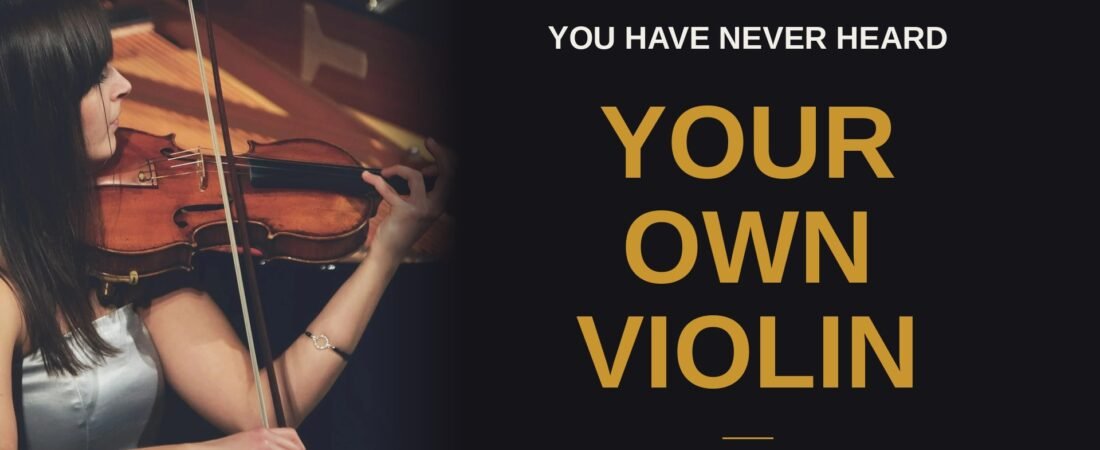
You Have Never Heard Your Own Violin
It is an instrument played against the player’s own skull. Which means the person who knows it best has never heard it IRL.
Which means the person who knows it best has never once heard it IRL.

Have you heard a recording of your own voice and thought that’s not what I sound like?
Everybody has, and everybody’s wrong in the same way. When you speak you hear two things at once. Some of it comes through the air, the way everybody else gets it. The rest travels through the bones of your skull straight to the inner ear, adding weight and warmth that exist for you and nobody else.
The recording is what you sound like. The voice in your head is a private edition of one.
Now put a violin under your jaw.
The instrument rests on your collarbone, carrying sound through bone, with an f-hole a few inches from your left ear. You’re not listening to a violin. You’re inside one.
A neural acoustic headset, built to replace headphones, lets a violinist do something no violinist has ever done. Step outside the instrument and hear it the way the audience does.
WHY DOES YOUR OWN INSTRUMENT SOUND DIFFERENT TO YOU?
Everybody else in the hall hears the violin from a metre away, or ten, or forty, in a room, with the air and the walls doing what they do. The player hears it from inches away, off to one side, mixed with sound through bone that nobody else in the building gets.
That’s rare in music. Malcolm Gladwell says it takes ten thousand hours to master something. A violinist spends every one of those hours refining an instrument they’ve never heard the way a single person in the audience hears it. They can’t get away from it while they’re playing it.
It’s the recorded voice problem, made permanent, and about the thing they’ve built their life around.
Players know it. It’s why they record themselves, why they ask a teacher to stand at the back of the room, why they trust the person in row twenty more than their own ears on the night.
WHAT DO IN-EAR MONITORS DELIVER ON STAGE?
Watch the violinists filling arenas now, in the style Lindsey Stirling made famous. They’re dancing through choreography that would be demanding with nothing in their hands, playing to thousands of people with a pack on the belt and in-ear monitors in.
Those monitors deliver the audio wave straight into the ear canal and bypass the outer ear.
Our outer ears sense every sound at a different level, with micro differences in timing, depending on the direction it comes from. Their ridges and hollows change it depending on where it came from and how far away. They deliver that information to our brains through the nerves and cartilage, and our brains create spatial reality from it.
It’s the master control panel of our sense of hearing.
Bypass it and what arrives is a mix. The violin at one level, the backing at another, everything in the centre of the head and nothing anywhere in particular.
They’re giving the most physical performance in classical music while being the one person in the building who can’t feel the room.
WHAT CHANGES WITH A NEURAL ACOUSTIC HEADSET?
Deliver the audio wave into the outer ear and the sound gets placed instead of centred. Our brains put it out into the space around the head, with height, distance and direction, because that’s what they do with everything the master control panel gives them.
The backing arrives as a stage, not a level. Add a single microphone facing the audience, mixed the way a singer sits their own voice in their earpieces, and the crowd arrives as a room with people in it.
The headset’s waveguide sits within the player’s own concha. Ordinary stereo goes in. No extra processing or software. It exists, and it’s available now.
For the stage, it’s built from the player’s own ears, so the choreography can be as wild as the music demands and nothing moves.
WHAT ABOUT THE RECORDINGS?
This is the part that catches players off guard, because it has nothing to do with the stage.
The engineers at labels like Deutsche Grammophon and Decca have spent decades capturing exactly where a violin sits in a hall. Where the instrument stood in relation to the microphone. How far back the room went. Whether the player was slightly left of centre and how high the ceiling was.
That’s a new dimension of physical reality, sitting in the file. None of it was deleted. It was captured by people who cared about it, then delivered by hardware that bypassed the master control panel.
Deliver it complete and a player hears other players the way the room heard them. Where the bow was. How far the sound travelled before it came back. What the hall was doing to it.
Violinists learned their craft by listening to other violinists. Hearing where the bow was doesn’t just make listening better. It changes what can be studied.
WHAT’S THE CATCH?
It works both ways. Your own recordings arrive with the same honesty as everybody else’s. Anything you’ve been getting away with in the middle of a fast passage is audible now. That won’t suit everyone.
A violin on the best headphones money can buy tops out around a 6.3 on the scale of what is recorded and what is real life. You hear every note. You don’t hear the hall.
A two out of ten on the scale could be one earbud in, the other hanging round your neck. Ten is real life in real life, row twenty of the hall with the violin forty metres away. One of the best Dolby Atmos studios on earth is an eight, maybe an 8.2. So why are people scoring a neural acoustic headset a nine or ten?
Every piece of audio tech, scored out of ten, is here
A violinist has spent a lifetime being told by other people what their instrument sounds like.
Now they can hear it for themselves.
WHAT DOES YOUR VIOLIN SOUND LIKE FROM ROW TWENTY?
Send me a recording of yourself playing, and one of the violinist you learned from. Those are the two we play.
The fastest way in is online, with a couple of photos of your ears. Or a demo IRL session comes to you. The practice room, the rehearsal hall, wherever you play.
When your pair arrives, an Audio Sommelier guides you through your demo IRL session. Binaural recordings first, made with a proper binaural microphone, an aircraft passing overhead and a babbling brook you’ll feel you’re sitting in, so your ears learn the new delivery. Then your two recordings, heard from row twenty.
For the stage, we take impressions of your ears, like hearing aids, and fit each side so nothing moves however hard you dance. Nothing mirrored, nothing averaged. Bespoke commissions are allocated by month, so if there’s a tour coming, the impression goes before it.
I’m at support@theaudiosommelier.com. I’d very much like the next violinist who hears themselves from row twenty to be you.
Mark O’Callaghan | The Spatial Audio Sommelier | NeuraSeals
Demo IRL sessions are held by appointment.
Order yoursRead next
 Why Are Pro Gamers Playing Like Their Car Door Mirrors Are Taped Over?
 Why Does The Album Never Sound Like The Gig, Even With Dolby Atmos?
Cover photo: Michel Catalisano / Unsplash