
The Spatial Audio Sommelier · Science and Discovery
Finally. We Can’t Tell If It’s a Recording or If It’s Real.
Whether you’re a student, just starting out, or mixing spatial audio for a living, and especially if you’re winning awards, a neural acoustic headset puts you in the immersive studio wherever you are.
And if you love listening to spatial mixes, it turns them into a new dimension of reality you can’t tell from the one you’re sitting in right now.

Finally. We can’t tell if it’s a recording or if it’s real. That’s the sentence I spent years trying to earn. It started with a pair of in-ear monitors that seemed broken.
My best friend Vance and I had custom sets made for us at a motorcycle week event, the same trip we opened a thirty-year-old bottle of Scotch together. Vance was a lawyer in Florida. He loved Disney and he lived for experiences, and he made every one of them bigger just by being in it.
These were supposed to be some of the best in-ear monitors in the world, the kind professional musicians wear on stage. When they arrived a month later we put them in and looked at each other. I said, these don’t seem to work. He said, mine either. They sounded small, tinny and disconnected, and turning up the volume did nothing at all.
They weren’t broken. That was the moment.
THE FACTORY
So I got on my motorcycle and rode to the factory. That tells you quite a lot about how the next few years went.

I saw how they were engineered and how tiny the drivers were. Then I talked to a bunch of their engineers and the owners. Everybody was very generous with their time. After that I decided to make them better. I wanted to hear music properly on my motorcycle at ninety miles an hour.
I’d spent years cutting sound and music for picture and working on film sets, some of them very big ones. I built a small recording studio in Scotland with a whisper room, walls made of baffle boxes inside a fully soundproofed space. I knew what great sound could feel like. And every time I put on something expensive and beautifully engineered, that same wee feeling was still there.
There has to be more.
I took what the factory taught me and spent years learning how audio waves move and how the human ear is built. I made silicone impressions of my own ears with tools from a hardware store. I paired them with small speakers and hand-shaped my first brass waveguide. A Dremel tool, a garage, and rooms that smelled of solder and silicone.
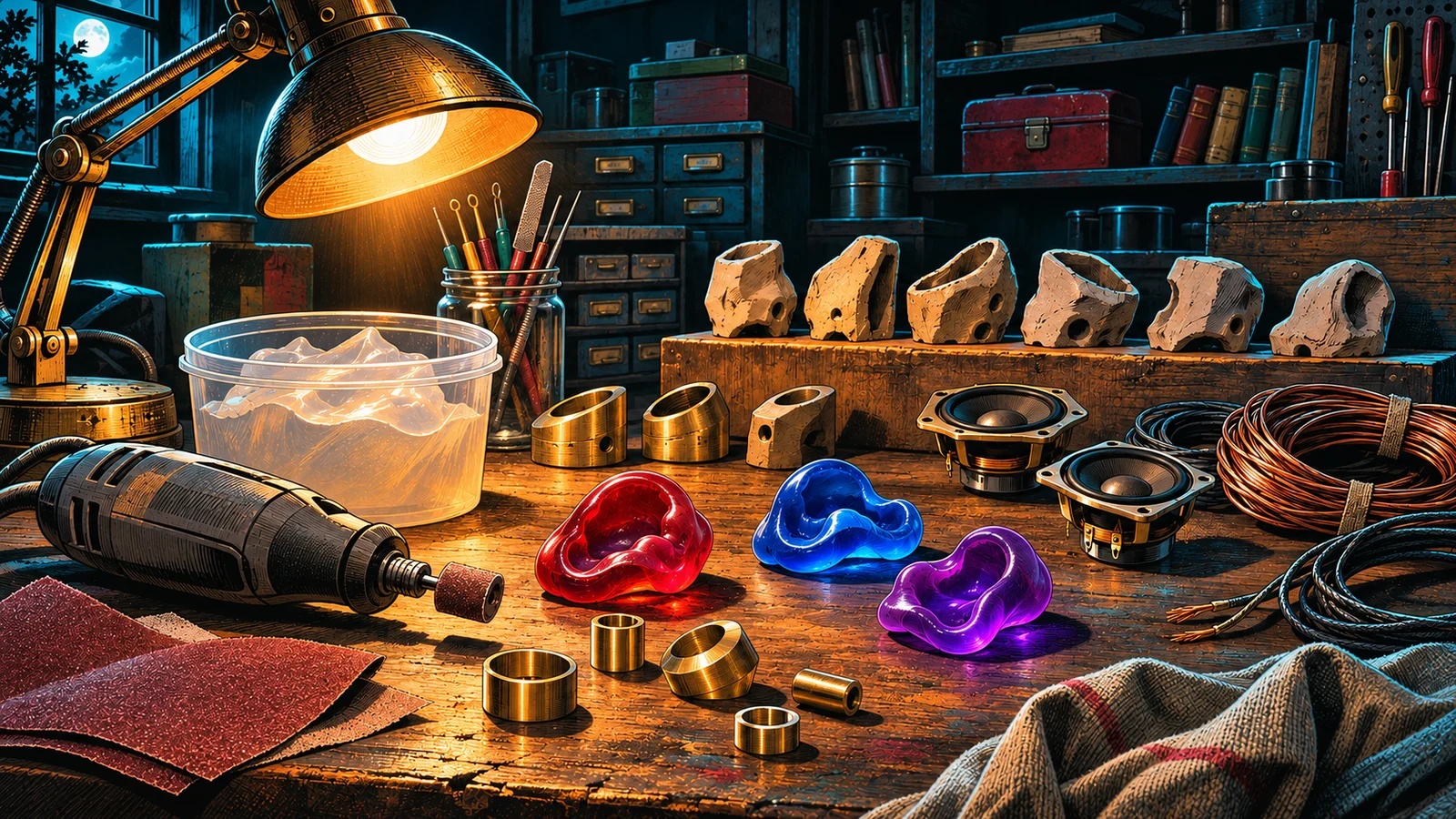
People told me I was chasing something that didn’t exist, that the physics wouldn’t support it and that the market had no interest.
THE AFTERNOON I PRESSED PLAY
Then one afternoon, alone in a room, I pressed play.
AC/DC came on, and I sat down on the floor because my legs stopped working.
I’d built the prototype with my own hands. I knew exactly where the sound was coming from. But the room around me had stopped being the place I was. I was on stage with the band.

I’d heard some extraordinary systems. Dolby Atmos rooms, IMAX cinemas, the best headphones ever made. I’d never had one put me there.
We have a whole vocabulary for judging audio equipment. More detail, better separation, a bigger soundstage. We have almost no language for what happens when a recording suddenly feels like somewhere we are. All I could say was, “I’m there.”
There’s a name for that experience now. Listening IRL.
That garage grew into 3D scanners, top design engineers and hundreds of iterations of waveguides and materials, every one built and tested deliberately.
WHAT IS A NEURAL ACOUSTIC HEADSET?
That afternoon is where the neural acoustic headset began, built to replace headphones. I invented it so recorded sound could give us the same physical presence real life does, with height, depth and a place for everything around us. Recordings stop being copies. They become a new physical dimension of reality through sound.
Our outer ears are the master control panels of our sense of hearing. They take the spatial information in and deliver it to our brains. Headphones deliver the audio wave to the ear canal and bypass them completely. A NeuraSeals neural acoustic headset aims at the incredibly sensitive nerve cluster and cartilage in our outer ears, which together become the master control panels for our entire sense of hearing.
The headset’s waveguide sits within your own concha, so an ordinary stereo recording reaches the whole of the outer ear the way it was designed to receive sound. No extra processing or software. It’s protected by two patents and eight granted registrations.
WHY DO OUR EARS SHAPE SOUND?
When did you last look closely at your outer ears? The curve of the helix, the antihelix curling through the middle, the deep bowl of the concha, and that little flap in front of the canal, the tragus. It’s a surprising amount of design for the bit of us that goes numb in a Scottish February.
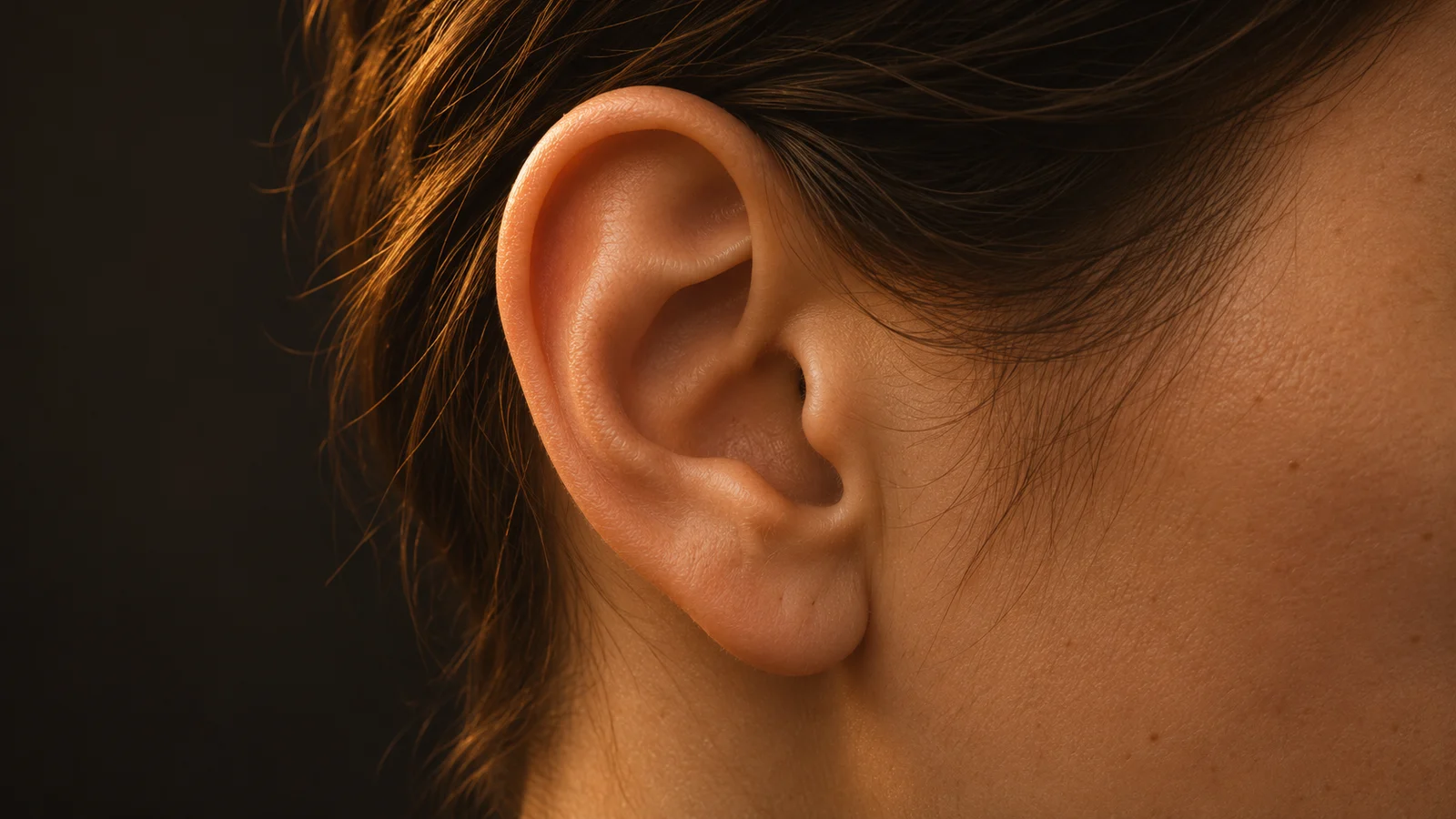
Sound arriving from different directions hits those ridges and curves differently. Some frequencies get lifted and others get cut, depending on whether the sound comes from above, below, in front or behind. Our brains take those patterns, add the differences in timing and loudness between our two ears, and create a physical world out of them.
It’s just the height. There’s actual height here. It’s there.
In 1998 Paul Hofman, Jos Van Riswick and John Van Opstal, publishing in Nature Neuroscience, changed the shape of a small group of adults’ outer ears by fitting moulds into them. The sounds were still perfectly audible. But their ability to judge height collapsed straight away.
Over the following weeks they learned the new shape. Then the moulds came out, and their old ears worked again immediately. Learning the new ears hadn’t erased the old ones. We spend our whole lives learning the shapes of our own ears without ever knowing we’re doing it.
In 1993 Elizabeth Wenzel and her colleagues at NASA looked at what happens when people listen to spatial audio built from somebody else’s ears. Sounds in front were heard behind them, and height got much harder to judge.
I kept coming back to those wee ridges and hollows. What would happen if I designed for them instead of around them?
MUSIC WITHOUT PUNCTUATION
What would a book feel like if it was written by somebody whose keyboard only had letters, numbers and a space bar? No capitals, no paragraphs and no punctuation of any kind.

We’d get the gist. We’d follow the story. But we’d be missing something profound, because punctuation isn’t decoration. It’s instruction. It tells you when to pause, when to feel the weight of something, and when one thing matters more than everything around it.
That’s where we’ve been with personal audio. All the notes are there. But we’ve been listening to music without the height, the depth and the direction our outer ears were designed to deliver. We’ve been reading the greatest music ever written in one long unbroken stream of lowercase letters.
Our nervous system doesn’t ask, is this accurate? It asks, do I believe this? The first time I heard a recording on my own headset, the punctuation came back. That’s the only way I know how to describe it.
THE KNOCK AT THE DOOR
In 2004 Hiroshi Hosoi at Nara Medical University in Japan found that a vibrating transducer placed against the outer ear produces sound inside the ear canal, because the cartilage itself vibrates. Hosoi calls it the third pathway, alongside air and bone.
That research told me the outer ear was doing far more than funnelling air. It’s why I call our outer ears the master control panels of our sense of hearing.
I found out how much that matters on an early handmade prototype, locked into my own antihelix and concha. I wasn’t playing music. It was a short binaural recording of a barber’s shop, the kind you may have heard on YouTube. There was a knock at the door, and my head turned. No decision and no thought.
Somebody was at my door. That’s what my body was sure of. I stopped the track and played it again, and the same thing happened. Then the clippers buzzed close to my ear, and I felt them on my ears. I’d heard that recording a few times on regular headphones. If you know it, I’m not exaggerating and I’m not joking.
That was the moment it clicked. Why did I just move? I’ve watched hundreds of people ask themselves that same question since.
THE TOWEL
Back when theBlu was the VR experience everyone wanted to try, and VR rigs were still wired to a computer through cables in the ceiling, one of its designers wore a neural acoustic headset alongside his VR rig at a studio in London. A massive whale glided past the deck of a sunken ship.

When he took everything off, he reached for a towel, because his skin felt wet. He told me it was the first time he’d ever felt like he was actually inside his virtual world.
A gamer at Insomnia in 2019, Christian, put it in the fewest words anyone has.
“It’s like in real life. I couldn’t make the difference between real life and with these ones.”
That’s the headline of this whole piece, in a gamer’s own words. We can’t tell if it’s a recording or if it’s real.
THE STRING NOBODY COULD FIND
A producer who worked for years with one of the most famous bands in the world had lived with one of his own recordings for over three decades. He always knew something was slightly off and could never find it.
We put on his song, and within seconds a look of pure shock came over his face. One guitar string was ever so slightly out of tune. He called the headset the holy grail of audio, and that was an early prototype with an 8mm driver.
Anthony Martin had a helicopter pass over him in a session and said, “I’ve never heard above me.” Then he put the whole thing better than I ever have. “My mind’s telling me it’s not a reality. But my ears are telling me it’s a reality.”

The first time ’bad guy’ by Billie Eilish played on my headset, I went back to a conventional system to check whether somebody had given me a remix. Nobody had. And the first time Yo-Yo Ma played on it, I was the cello.
Once you feel it, you can’t unfeel it.
WHAT HAPPENS IN A DEMO IRL SESSION?
A demo IRL session starts with your ears and your fit. Then an Audio Sommelier guides you through a sequence of binaural recordings with your eyes closed. A helicopter and an aeroplane pass directly over your head. Bees fly around you, and a couple of them land on the microphones, which feels like they’ve landed inside your ears.
A babbling brook works like the world’s best meditation app. Then fireworks over Boston, recorded from a hill, exploding in every direction with people talking around you at different heights and distances. Paul Watson sat through the fireworks and said, “It’s just the height. There’s actual height here. It’s there.”

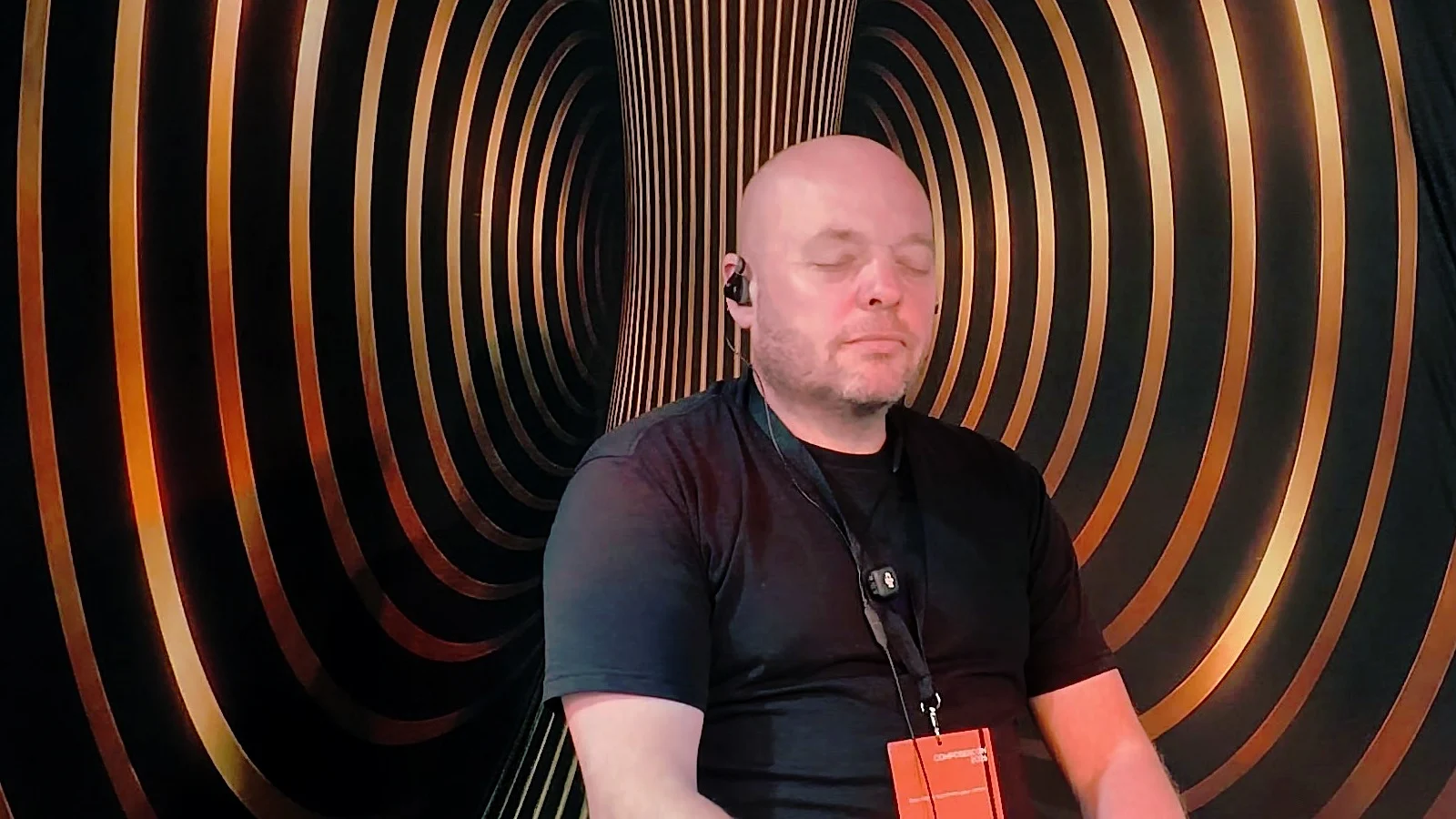
Then we put on something you love, from your own phone, streamed and compressed the way you normally hear it. You’ll hear the compression. You’ll also hear things in that song you’ve never heard before.
A vice president of a company I was working with went through the full sequence and asked for Justin Bieber. As a fellow Canadian I was more than happy to oblige. The song was fourteen years old. By the time it finished her eyes were brimming, and it took her a minute or two before she could speak.
THE THINGS YOU DON’T HEAR
Ceri Thomas helped write the spatial listening room standards for Dolby and Apple. He designs the rooms the best spatial mixers in the world work in. In his session he played a Dolby Atmos mix he knows inside out, Bradley Cooper and a guitar from A Star Is Born, mixed down to two channels by the spatial audio renderer on his laptop.
It was the first time he’d heard the thirty feet of reverb behind him without walking to the back of a mix room. “I knew everything was there,” he said. “I just didn’t hear it.”
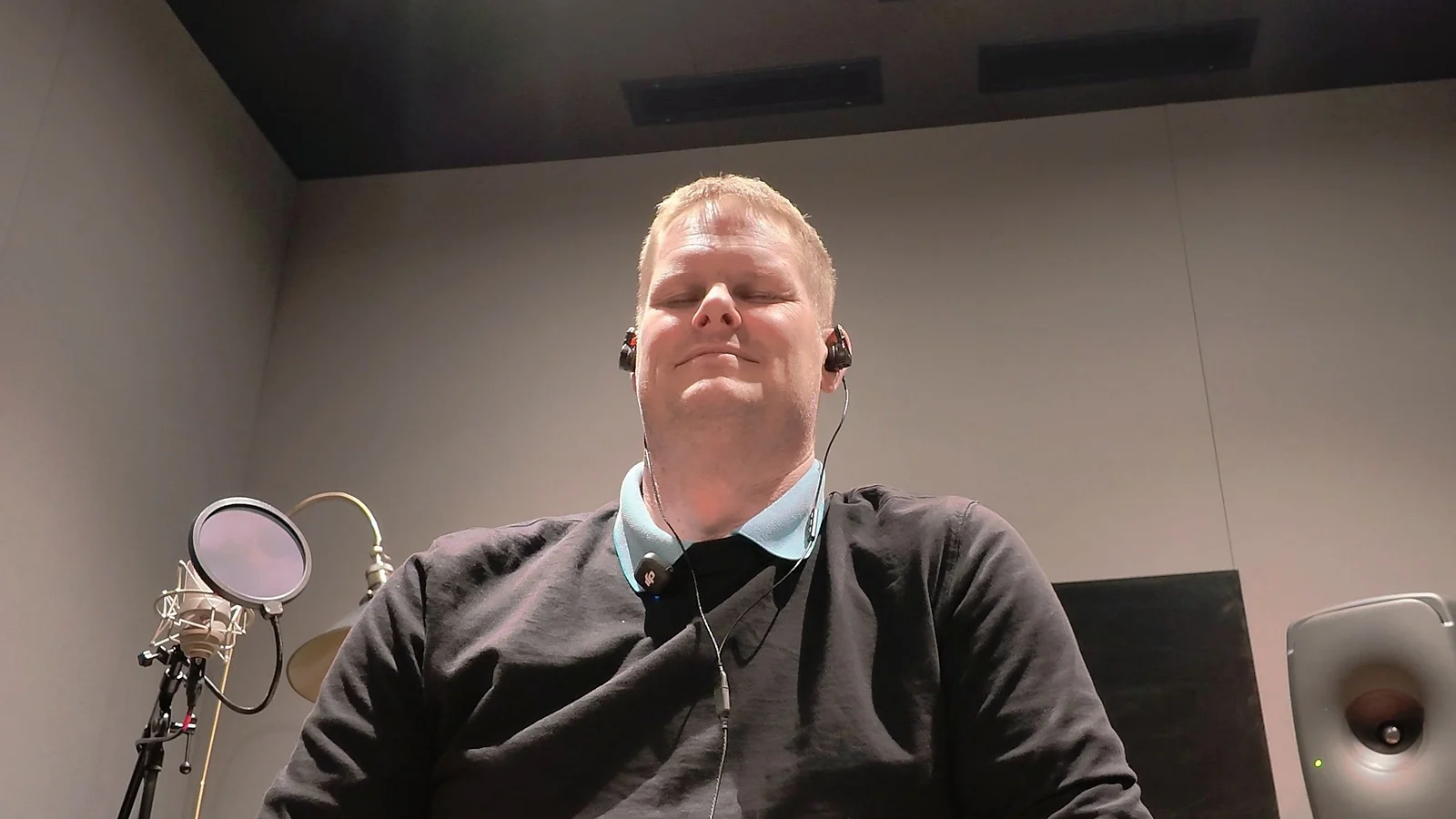
Then he said the line every creator should pin above their desk. “The things you don’t hear are the things that kind of make the hairs on your neck tingle.”
Spatial audio was built to feel like real life. Now it can be delivered that way.
Ceri was hearing that Atmos mix on a laptop, and it was like standing in the mix room. Anyone mixing in Dolby Atmos, Sony 360 Reality Audio or Apple Spatial Audio can now carry that room in their bag.
And everything they place above us and behind us finally arrives where they put it, for everyone listening.
For filmmakers, a whisper can be placed just behind the listener’s ear, and they turn before they’ve decided to. For musicians, the fan puts on a headset and the artist is suddenly in the room with them. I build the headset and you build the space.
Once you’ve watched enough people’s bodies respond before they understand why, you stop asking whether something sounds good and start asking what it does to someone.
THE CATCH
There’s one, and I tell everybody about it.
If a recording is muddy, the headset magnifies the mud just as much as everything good. Some badly mixed audio becomes close to unlistenable, and it’ll sound better through speakers or bog-standard headphones.
The shite is more shite.
A phone speaker playing AC/DC could be a three out of 10 on the scale of what is recorded and what is real. A one is the speaker in a train station ceiling. Ten is real life in real life. That afternoon on the floor was the first time a recording had ever given me a ten.
So why are people scoring 9 or 9.5 or 10 out of 10 when wearing a neural acoustic headset?
Every piece of audio tech, scored out of ten, is here
VANCE
Vance passed away from a heart attack years ago. He never heard what that afternoon at the motorcycle week became. I miss him very much.
I kept sitting down with people and pressing play, and the sentence that stayed with me was always the same. I was there.
Somewhere there’s a song you’ve played a thousand times, the one you know inside out. It has always held the room it was recorded in, the height, the depth and the breath of the people who made it. Your outer ears have always known what to do with all of it. Headphones never gave them the chance.
Which song do you want to be inside first?
Neural acoustic headsets are available now.
The sized version is matched from a photo of each ear, like buying shoes. Or upgrade to a custom pair made from your own ears, each side from its own ear.
When your pair arrives, an Audio Sommelier takes you through the helicopter, the bees, the brook, and then the song you know inside out.
Order yoursTell me your song at support@theaudiosommelier.com.
Student? Ask about student pricing at support@theaudiosommelier.com.
Mark O’Callaghan | The Spatial Audio Sommelier | NeuraSeals
Motorcycles: Ralph Katieb / Unsplash · Concert: Pexels · Illustrations: N-Pop for The Audio Sommelier