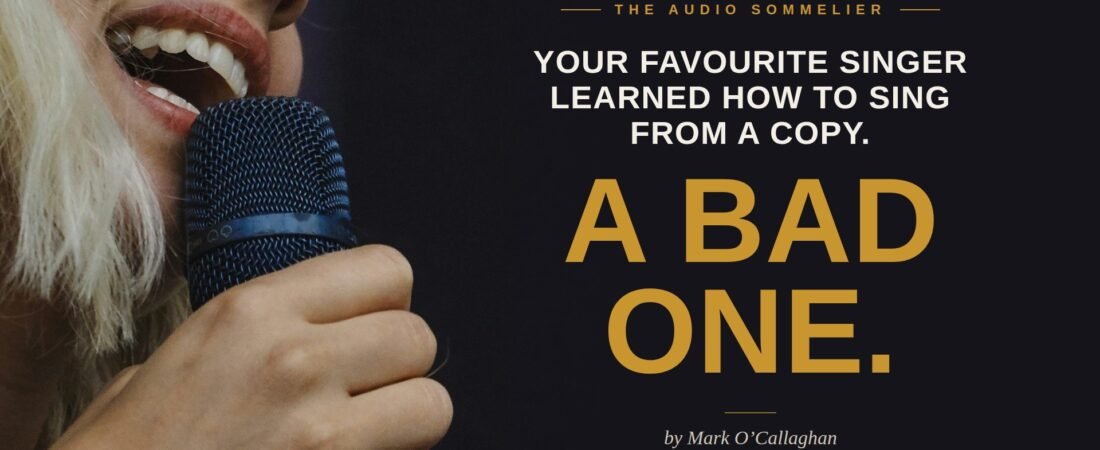
Every vocalist was taught by listening to other vocalists.
What happens when they get to do it IRL for the very first time?
Have you tried to cook something from a photograph? Not a recipe, a photograph? The finished dish sitting on a plate with perfect lighting. You could see exactly what the finished dish is meant to look like. What we could not see? The list of ingredients, the cooking times, the methods used or even the measurements.
That is how every singer you have ever loved learned to sing.
Nobody is taught to sing the way we are taught to read. With singing you are taught the mechanics for a while, breath, support, placement, and then you spend twenty years listening. You put a record on and you copy it. You work out what they are doing at the top of the line, what they do with the consonant at the end of each word, and you try it over and over again in your own throat until something works for you. The entire craft is transmitted by ear. Each new generation of singers copying what everyone did before them combined with a whole lot of trial and error and improvisation along the way.
Up until recently most of this information has been transmitted through the equivalent of that photograph.
WHAT A VOICE IS ACTUALLY MADE OF
A voice is not a note. A note is the least interesting part of it. What makes a voice recognisable across a crowded room is a set of physical events that all happen in a very small space at a very high speed. The tongue changes shape as it moves forward or back and up or down. The jaw opens or closes or clenches and breath is taken at the proper moment and how much of it is needed. Maybe the soft click at the front of a word and the exact moment the throat lets go of it all and where the breath comes from.
All of that and so much more is in the recording. It has always been. Microphones have been good enough to capture it since long before you were born, and any engineer will tell you they spend their working life chasing exactly those details and putting them in the mix on purpose.
It is what happens in the headphones or speakers on the way to your ears that loses so much of this precious information.
Conventional hardware aims and tunes drivers and speakers for our ear canals. This effectively means the majority of the spatial and most subtle sound signals bypass our outer ears completely and we are only able to receive a signal that is only identifiable as a recording.
Our outer ears, the ridges and folds we have rarely, if ever, thought about, are not decorative. They are the structures our bodies use to work out where a sound is and what shape the space around it has. Personal audio has spent its entire history going past our master control panels for hearing, going straight for the eardrum.
What survives is the note. What is lost is almost everything the note was made out of.
When people are learning vocals they probably learned to copy the note. Almost everyone does. Generations of singers have learned their craft from a version of their heroes with the physical evidence stripped out. Some of them got extraordinarily close, because good singers have good ears and a lot of patience. All of them who practised with recordings were working harder than they needed to.
THE CHEF IN THE KITCHEN
A working singer sat down with me recently and I gave her an interface built to engage both of her complete outer ears. I ran her through the Listening IRL so her ears could learn how to interpret the new signals and then we put on a recording she had known for most of her life.
She did not say it sounded better. She said she could hear the tongue placement and shape. She could hear the jaw and throat position. She could hear where the breath was taken and how much was left at the end of the phrase. Then she said she could now reproduce that singer more accurately than she ever had before.
That was not only a mind-blowing experience, this would become an essential working and training tool.
That same photograph she had looked at for years, suddenly transformed into the chef themselves, standing behind her in the kitchen, personally guiding her on how to prepare the meal from scratch.
THE COST
There is a cost with this new technology. Neural acoustic interfaces deliver the good, the bad and the ugly. Singers will finally be able to hear their own voice with honesty and clarity. Everything they are proud of will be magnified by spatial reality and every habit they may have been hiding behind for twenty years will be laid bare, exposed and raw. Some singers might not want that, but the ones who do are the ones who will get the most out of this new level of listening where we cannot tell the difference between recordings and real life.
And for those of us who love listening to them, we might get the most from this new connection to music than anyone.
None of this is new information. It was in the grooves in 1971 and it is in the file on your phone tonight. It was recorded deliberately, by people who cared about it, and then it was thrown away because of the hardware somewhere between the recording and your ears.
Every singer alive has been learning from a copy.
Nobody told them the original was always buried deep inside it.
Custom Fitting and Listening IRL Sessions are held by appointment. theaudiosommelier.com/book
Cover photo: Vidar Nordli-Mathisen / Unsplash