
The Spatial Audio Sommelier · Industry Voices
There’s Actual Height Here.
If you love listening to spatial mixes, everything the mixer put above you finally arrives over your head. And everything the mixer put below you finally arrives at your feet, through a headset.
And if you mix spatial audio, whether you’re a student, just starting out, or doing it for a living, and especially if you’re winning awards, a neural acoustic headset puts the immersive studio in your bag.
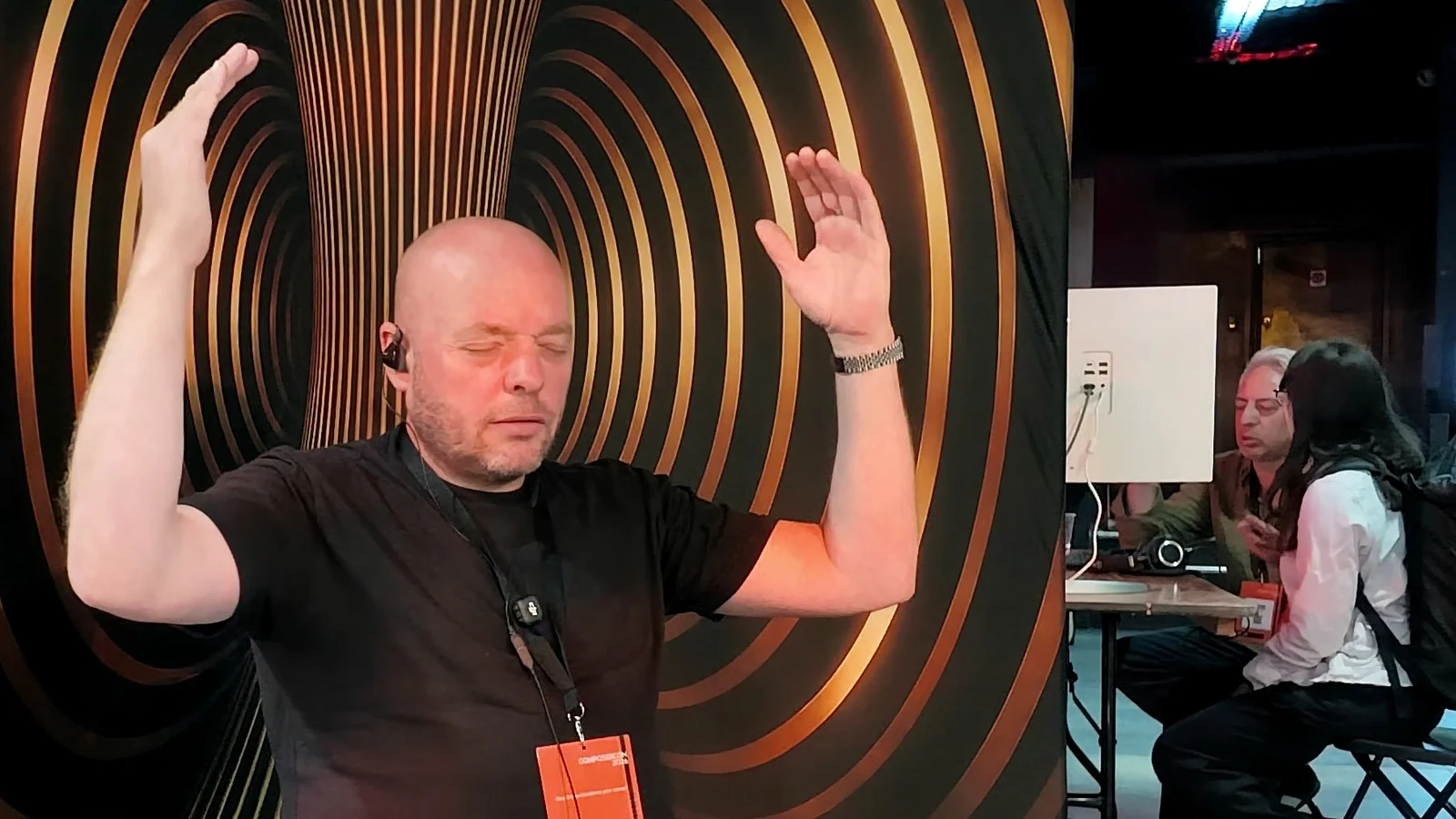
THE WEEKEND THE AUDIO WORLD MOVED INTO TILEYARD
On the 18th and 19th of September, a big part of the audio industry fitted inside one estate in King’s Cross. GearCon LDN took over Tileyard London for two days, and it didn’t feel like a trade show. It felt like Willy Wonka’s factory for people who make sound.
Headliner Group built it with Tileyard. That’s Paul Watson, Rian Zoll-Khan and Richard Dickerson, the team behind Headliner magazine, alongside Nick Keynes and the Tileyard crew. That’s where I met Paul and Rian.
There were live sets, studio workshops, keynotes and panels running from morning till night. Dolby ran demonstrations. Teenage Engineering, Eventide, Ableton and Buchla had their kit out for anybody to play. One table was covered in instruments you can play with a single button. In another room, people lay on a bed that lets you feel music through vibration.
When Headliner announced GearCon, Rian said it was a chance to create something “with real energy”. And they succeeded on every level. There was amazing music, drinks and food, and everybody involved, from the visitors to the exhibitors, created an electric atmosphere that was a pleasure to be a part of.
FOUR DAYS LATER, COMPOSERCON
On Wednesday the 23rd, Vikram Gudi’s Elephant Music filled EartH in Dalston with composers for ComposerCon, a whole day on the craft, career and future of writing music, and I was fortunate enough to have a space to give Listening IRL Sessions with my neural acoustic headsets.
There were panels on AI tools, spatial audio, sync licensing and publishing, with people from Netflix, Apple and Spotify on stage. Brands demoed their kit between the talks.
That’s where Paul, Rian and Richard sat down and tried a neural acoustic headset for the first time.
WHAT A NEURAL ACOUSTIC HEADSET DOES
A neural acoustic headset is built to replace headphones. Headphones are brilliant at delivering the audio wave to the ear canal, but they bypass the master control panels of our sense of hearing. Those are our outer ears, the ridges and curves that take in where every sound is and deliver it to our brains, through the nerves and cartilage there.
The neural acoustic headset delivers an ordinary stereo recording to the whole of the outer ear, the way it was designed to receive sound. No extra processing or software, and it creates a new realm of reality, unlike anything we’ve ever experienced before.
PAUL IN THE CHAIR
Paul Watson’s magazine covers the gear the whole industry works with. At ComposerCon, he sat down for his Listening IRL Session.
Every Listening IRL Session starts the same way. Eyes closed, and a binaural recording made with a proper binaural microphone. An aeroplane and a helicopter pass over your head.
“It’s all giving me a bit of a funny feeling,” Paul said, “and in a good way.” Then, “It actually nearly made me cry. It’s absolutely ridiculous.”
That’s Paul below, pointing to exactly how high the helicopter flew over his head. Because it has real space.

THE BEES
Next comes a swarm of bees, recorded binaurally, and a couple of them land on the microphones. With a neural acoustic headset on, it feels like they’ve landed inside your ears.
“It’s just like you’re in a swarm all around you,” Paul said. “Coming into my ears.”
I asked him whether any of them touched him.
“Two or three of them did.”
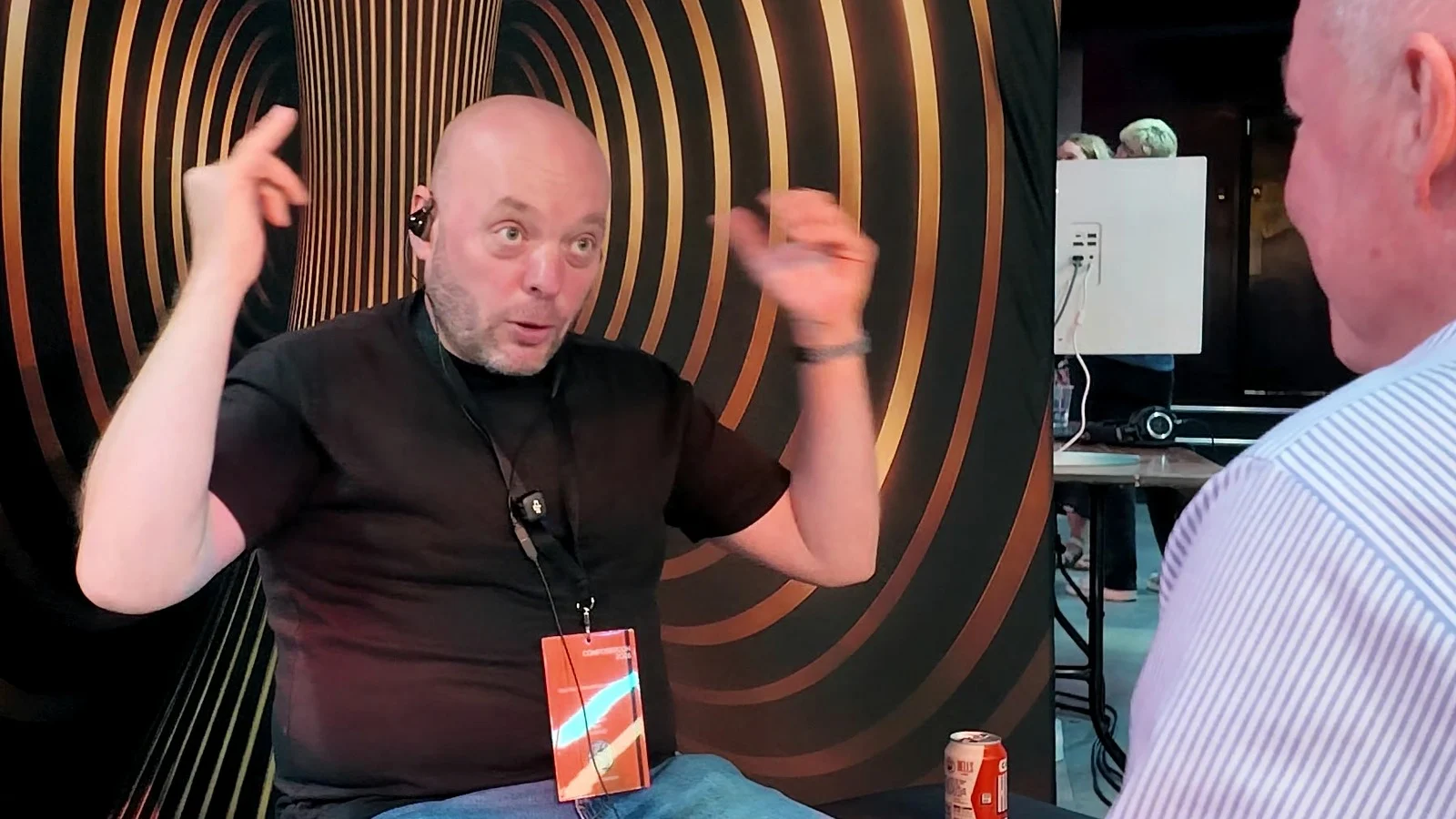
I must admit, at that point I apologised for touching him inappropriately with sound.
THE STREAM IN THE LAKE DISTRICT
Then I play a babbling brook. It works like the world’s best meditation app, and nobody knows where it’s going to take them.
It took Paul back 25 years, to a little stream by a waterfall in the Lake District, where he and a friend sat and wrote a song together.

I haven’t thought about that for 25 years.
That’s what I mean when I say this is about connection, not just space. A recording found a memory he’d filed away a quarter of a century ago. People seem to connect to music, movies, games and experiences through sound in ways that have never happened before, and on levels that are absolutely incredible to witness.
CAN HEADPHONES GIVE YOU HEIGHT?
The last binaural recording is fireworks over Boston, recorded from a hill. They explode in every direction, with people talking around you at different heights and distances.
Paul sat through all of it and said the sentence I’d put on the side of a bus.
“It’s just the height. There’s actual height here. It’s there.”
Height and depth are the two things headphones have never been able to truly give us. On the scale of what’s recorded and what’s real, a one is the speaker in a train station ceiling and a ten is real life in real life. Headphones top out at a 6.6. There’s no true height. Things don’t typically fly right over your head. And there’s nothing below your head level. Things don’t land at your feet. No sound arrives truly over your head or truly beneath you, which is what makes a neural acoustic headset such a remarkable experience.
Every piece of audio tech, scored out of ten, is here
RIAN AND RICHARD
Rian had his session too. I played him the Omaha Beach landing from Saving Private Ryan.
In the landing craft, a soldier throws up. With a neural acoustic headset on, it lands at your feet, and people actually look down.

“It’s putting you into the scene,” Rian said. “That’s what it’s doing.”
Then we watched some scenes from Call of Duty, a first-person shooter, off a phone. The sound is so complete, it looks like people’s autonomic reflexes kick in, just like real life. Rian explained it really well when he said, “You can hear everything. That’s cheating.”
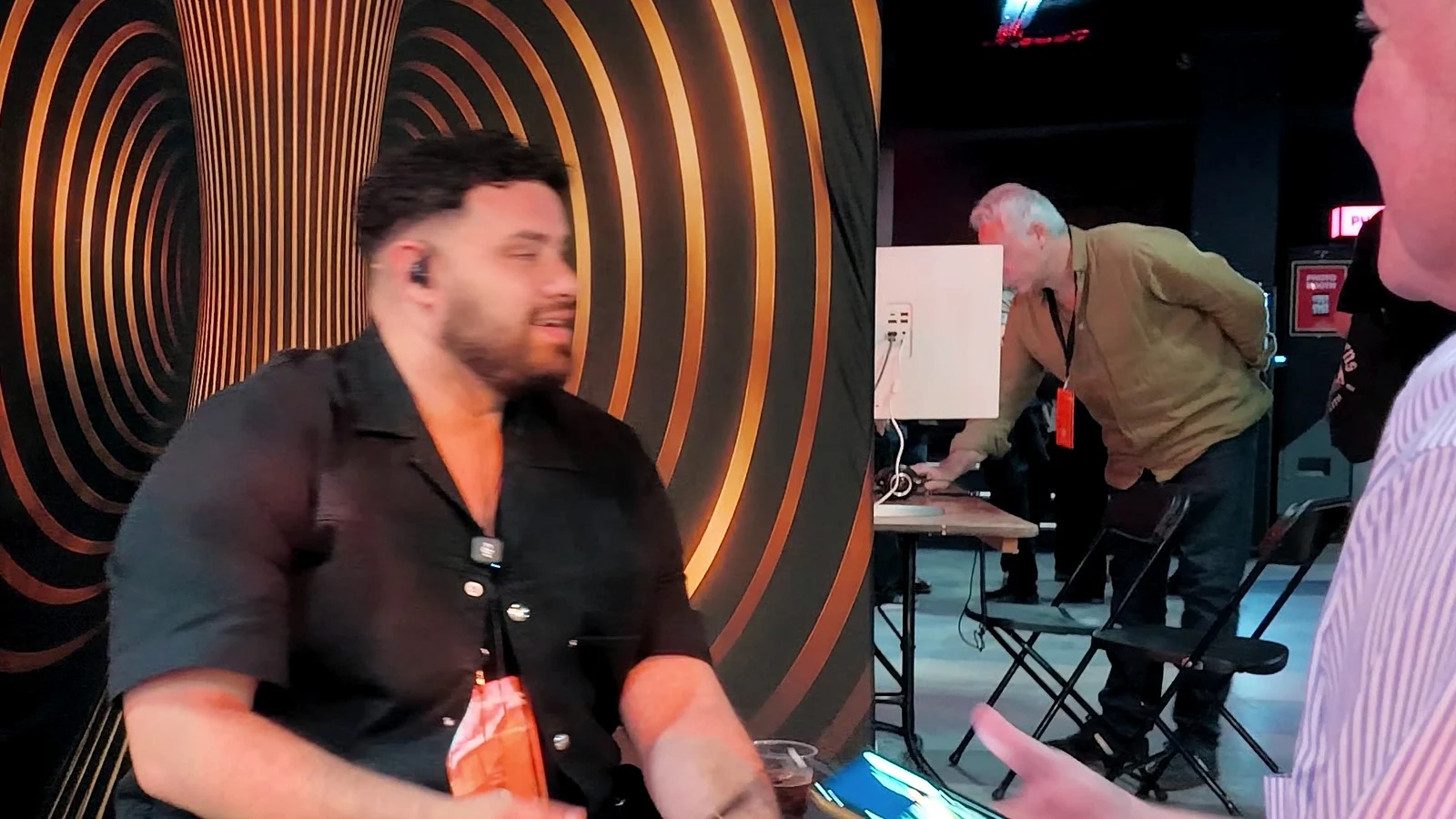
I’ve actually had some professional players accused of cheating, because they can hear things nobody else can in the games, like footsteps behind walls.
Richard Dickerson reviews the tech for Headliner, and music is mainly what he does for a living. After the helicopter I asked him where it sat on the scale, with a mono earbud at one and real life at ten. Richard told me, “That sits pretty close to level ten.”
After the brook I asked him if he’d ever heard water like that before.
“No,” he said. “Well I have, but only when I’ve been there sitting on the riverbank.”
At the end I asked him, “Did I tell you the truth, or did I exaggerate?”
“Yeah, you are telling the truth.”
And then the reviewer in him. “I know exactly what you’re talking about. And I’m fully aware that the ear is an interesting instrument, and of course it’s not just the inner ear that’s responsible for giving you an impression as to where things are.”
THE SPEAKERS THAT FOLLOW YOUR EARS
Audioscenic and I are chasing the same thing from opposite ends. They start from the speakers. I start from our ears.
Audioscenic, the Southampton company now run by Chris Spearing, gave the first public demo of its SBX-1 Spatial Studio Monitor at GearCon, and brought it to the composers at ComposerCon too. If you’ve never heard Audioscenic, here’s what they do.
Binaural audio is recorded the way two ears hear. Play it through speakers and it normally falls apart, because each of your ears hears both speakers. Audioscenic cancels the sound meant for the other ear. Your left ear gets the left, your right ear gets the right, and there’s nothing on your head.
Then a camera and machine learning follow where your ears are. Move your head and the sound stays exactly where it was. Older systems like this only worked if you sat dead still in one sweet spot, like the guy in the armchair in that old Maxell advert, pinned to his seat. Audioscenic lets you get up out of the armchair.
It’s already inside gaming soundbars, laptops and monitors from Razer, Lenovo, Acer and Dell. The SBX-1 puts it in a portable box built for people who mix. It’s brilliant engineering, and the people who designed it really hit it out of the park.
WHAT THIS MEANS FOR SPATIAL MIXERS
Every spatial mix creates its own realm of reality. We’ve just never had the hardware to deliver it before, so we can tell everything we’re listening to is a recording. Until now.
Dolby Atmos, Sony 360 Reality Audio and Apple Spatial Audio were built to put sound above us, behind us and below us, in a full sphere, just like real life. Mixers place a sound overhead in a room with speakers in the ceiling. Then most of us hear that mix on headphones, and the height and the depth are minimised.
Paul heard height from an ordinary stereo binaural recording, and we not only created a new realm of reality for him through sound, apparently we touched him inappropriately with bees.
Anyone mixing in Dolby Atmos, Sony 360 Reality Audio or Apple Spatial Audio can now carry the immersive studio in their bag, and hear exactly where they put every sound. And everyone listening finally gets it where it was placed.
Audioscenic gives you that from speakers on your desk. A neural acoustic headset gives it to you anywhere you can plug one in.
THE PEOPLE WHO BUILT THE ROOM
GearCon was two days of people who love sound putting it in front of everybody else, and Paul, Rian and Richard made it happen.
So here’s my question for you. What’s the first mix you’d want to hear height on, or hear something land at your feet?
Neural acoustic headsets are available now.
The sized version is matched from a photo of each ear, like buying shoes. Or upgrade to a custom pair made from your own ears, each side from its own ear.
When your pair arrives, an Audio Sommelier takes you through the helicopter, the bees, the brook, and then the mix you know inside out.
Order yoursTell me your mix at support@theaudiosommelier.com.
Student? Ask about student pricing at support@theaudiosommelier.com.
Mark O’Callaghan | The Spatial Audio Sommelier | NeuraSeals
Photographs: The Audio Sommelier, ComposerCon, London, September 2026